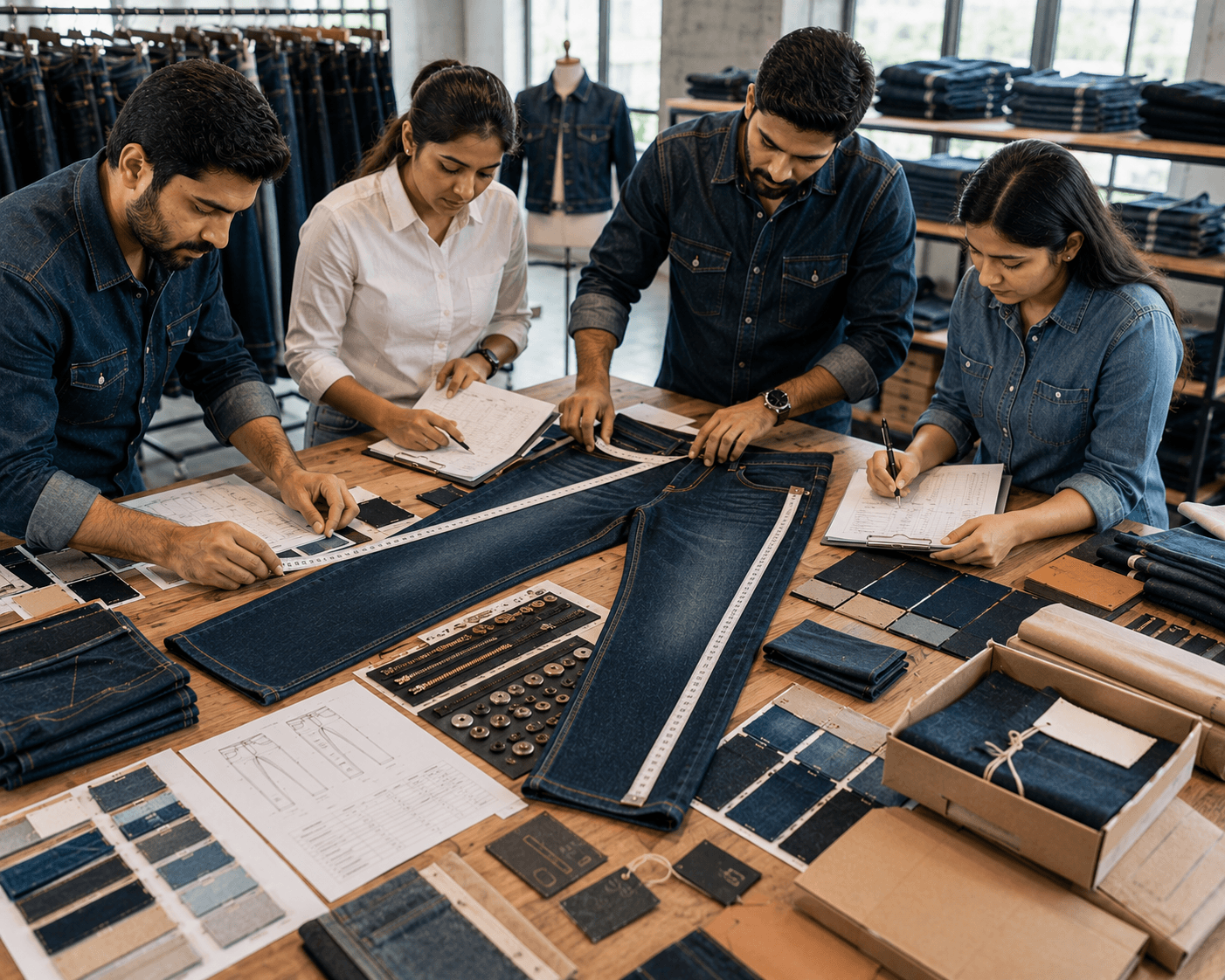
Sample approval is one of the most important stages in men’s denim manufacturing.
A sample allows the buyer to verify whether the manufacturer has correctly interpreted:
- Fit
- Measurements
- Fabric
- Construction
- Wash
- Trims
- Branding
- Packaging
Approving a sample too quickly can create expensive problems during bulk production.
A small error in one sample can be repeated across hundreds or thousands of finished garments.
The buyer should therefore treat sample approval as a technical and commercial decision, not a casual visual check.
Why Sample Approval Matters
The approved sample becomes a key production reference.
It may be used by:
- Pattern team
- Cutting team
- Sewing team
- Wash unit
- Finishing team
- Quality-control team
- Packing team
- Third-party inspector
A complete approval process helps reduce:
- Fit complaints
- Measurement variation
- Incorrect wash shades
- Construction defects
- Hardware problems
- Label mistakes
- Packaging errors
- Production disputes
The sample should reflect the final product as closely as possible before bulk manufacturing begins.
Types of Men’s Denim Jeans Samples
Not every sample has the same purpose.
A brand may receive several sample types during development.
| Sample type | Main purpose | Buyer should review |
|---|---|---|
| Development sample | Tests the initial design idea | General shape, construction and feasibility |
| Fit sample | Tests measurements and silhouette | Fit, balance, comfort and movement |
| Wash sample | Tests shade and finishing | Color, fading, whiskers, softness and shrinkage |
| Size-set sample | Checks grading across sizes | Proportion, size progression and fit consistency |
| Pre-production sample | Confirms final approved specification | All product details before bulk production |
| Shipment sample | Represents finished bulk goods | Final appearance, packaging and overall quality |
A development sample should not automatically be treated as a final production sample.
Each sample must be evaluated according to its intended purpose.
Development Sample
The first development sample helps determine whether the product concept is technically workable.
Check:
- Overall silhouette
- Basic construction
- Pocket shape
- Design balance
- Fabric suitability
- Approximate wash direction
- Branding concept
At this stage, several corrections may still be necessary.
Fit Sample
A fit sample focuses on:
- Waist
- Rise
- Seat
- Thigh
- Knee
- Leg opening
- Inseam
- Garment balance
- Comfort
- Mobility
The fit sample should normally use a fabric with similar weight, stretch and recovery to the final approved fabric.
A very different fabric can produce misleading fit results.
Wash Sample
A wash sample evaluates:
- Final shade
- Fading
- Whiskers
- Contrast
- Softness
- Abrasion
- Distressing
- Shrinkage
- Hardware reaction
The wash should be reviewed on the intended production fabric whenever possible.
Size-Set Sample
A size-set includes several or all sizes from the range.
It helps confirm whether grading remains balanced.
Check:
- Waist increments
- Rise progression
- Seat and thigh growth
- Knee and hem proportions
- Pocket placement
- Yoke proportion
- Overall silhouette
A good base-size sample does not guarantee that every graded size will fit correctly.
Pre-Production Sample
The pre-production sample should represent the final product.
It should use approved:
- Fabric
- Wash
- Pattern
- Measurements
- Trims
- Labels
- Stitching
- Branding
- Packaging
Bulk production should not begin while major pre-production issues remain unresolved.
Sample Approval Process
A reliable approval process follows clear steps.
- Confirm the sample version.
- Review the latest tech pack.
- Check the correct fabric and wash.
- Measure the garment.
- Evaluate fit on the intended body profile.
- Test movement and comfort.
- Inspect construction.
- Review stitching and reinforcement.
- Check trims and hardware.
- Review branding and labels.
- Check grading when applicable.
- Review packaging.
- Record all comments.
- Decide whether to approve, conditionally approve or reject.
- Issue written confirmation.
Step 1: Confirm the Sample Identity
Before inspecting the garment, confirm:
- Brand
- Style name
- Style number
- Sample type
- Sample size
- Tech pack version
- Fabric code
- Wash code
- Date
- Revision number
A sample may appear correct but belong to an older revision.
Do not inspect it without confirming which specification was used.
Step 2: Use the Latest Tech Pack
Keep the latest tech pack beside the sample during inspection.
The document should contain:
- Measurement chart
- Technical sketches
- Construction notes
- Fabric details
- Wash reference
- Trim list
- Label placement
- Packaging instructions
A complete men’s denim jeans tech pack helps create a measurable approval process.
Do not approve based only on memory or informal messages.
Step 3: Check the Sample Under Good Lighting
Wash shade and fabric appearance can look different under poor or artificial lighting.
Review the sample in:
- Neutral daylight
- Consistent indoor lighting
- A clean inspection area
Avoid evaluating shade next to strongly colored walls or surfaces.
When comparing two samples, place them under the same lighting conditions.
Step 4: Allow the Garment to Rest
A sample may become compressed during shipping.
Before measuring:
- Remove it from packaging.
- Lay it flat.
- Allow the fabric to relax.
- Smooth the garment without stretching it.
- Follow the agreed conditioning method.
Stretch fabrics may require additional relaxation time.
Use the same preparation method for every measurement review.
How to Measure the Sample Correctly
Measurements must follow the method defined in the tech pack.
Do not change the measuring technique between samples.
Common tools include:
- Flexible measuring tape
- Flat inspection table
- Ruler
- Angle guide
- Measurement diagram
- Approved sample
Important Measurement Points
Common men’s denim measurements include:
- Waist
- Front rise
- Back rise
- Seat
- Thigh
- Knee
- Leg opening
- Inseam
- Outseam
- Waistband height
- Fly length
- Front pocket opening
- Back pocket dimensions
- Yoke depth
Sample Measurement Review Table
| Measurement point | Specification | Actual sample | Tolerance | Result |
| Waist | 84 cm | 85 cm | ±1 cm | Pass |
| Front rise | 27 cm | 27.8 cm | ±0.5 cm | Fail |
| Back rise | 38 cm | 38.2 cm | ±0.5 cm | Pass |
| Thigh | 61 cm | 60 cm | ±1 cm | Pass |
| Inseam | 81 cm | 79.5 cm | ±1 cm | Fail |
| Leg opening | 38 cm | 38.5 cm | ±1 cm | Pass |
This table makes approval comments easier to understand.
Finished vs Before-Wash Measurements
Confirm whether the sample is being measured:
- Before washing
- After washing
- After pressing
- After garment conditioning
For finished jeans, the approval measurements should normally reflect the final post-wash product.
The manufacturer may also maintain separate before-wash specifications for production control.
How to Check Waist Measurement
The waist should be measured according to the agreed method.
Common variables include:
- Waistband aligned or naturally curved
- Button fastened or open
- Garment relaxed or stretched
- Half-waist or full circumference
The method must remain consistent.
Also check:
- Waistband shape
- Gaping
- Excessive stretch
- Waistband rolling
- Button placement
How to Check Rise
Front and back rise influence comfort and appearance.
A rise that is too short may create:
- Tightness
- Pulling
- Restricted movement
- Poor seat fit
A rise that is too long may create:
- Excess fabric
- Dropping
- Wrinkling
- Poor silhouette
Review rise both through measurement and on-body fit.
How to Check Seat and Thigh
The seat and thigh should provide the intended level of ease.
Look for:
- Horizontal stress lines
- Excessive pulling
- Loose fabric
- Twisting
- Pocket distortion
- Restricted movement
Ask the fit model to:
- Stand
- Walk
- Sit
- Bend
- Climb a step
- Move naturally
A sample that looks acceptable while standing may feel uncomfortable during movement.
How to Check Knee and Leg Shape
Confirm:
- Knee position
- Taper
- Straightness
- Symmetry
- Leg opening
- Side-seam alignment
The knee point should match the intended pattern and wearer proportions.
Uneven leg shape can indicate:
- Pattern imbalance
- Cutting error
- Sewing distortion
- Wash shrinkage
- Fabric skew
How to Check Inseam and Outseam
Measure both legs when necessary.
Check:
- Length consistency
- Seam twisting
- Hem balance
- Side-seam alignment
- Inseam smoothness
Leg twisting should be investigated because it may come from fabric skew or production handling.
Fit Testing on the Correct Person
Fit should be tested on someone close to the target customer profile.
The fit model should match the intended:
- Waist
- Height
- Seat
- Thigh
- Body proportions
Avoid using only the brand owner unless that person represents the target customer.
Fit Review Questions
Ask:
- Does the waistband feel secure?
- Is there enough room in the seat?
- Is the thigh comfortable?
- Does the rise feel correct?
- Can the wearer sit comfortably?
- Does the fabric recover after movement?
- Is the leg shape balanced?
- Is the hem opening appropriate?
- Are pockets comfortable and functional?
Record practical answers instead of relying only on visual judgment.
Fit Approval Table
| Area | Too tight | Correct | Too loose | Comment |
| Waist | ✓ | Secure without pressure | ||
| Seat | ✓ | Add ease | ||
| Thigh | ✓ | Movement acceptable | ||
| Knee | ✓ | Shape correct | ||
| Leg opening | ✓ | Reduce opening | ||
| Rise | ✓ | Comfortable |
Check Garment Balance
Garment balance affects how the jeans hang on the body.
Signs of imbalance include:
- Waistband rising at front or back
- Side seams moving forward
- Twisting legs
- Excess fabric below the seat
- Uneven hem
- Pulling around the crotch
Balance issues may require pattern corrections rather than simple measurement changes.
Fabric Evaluation
Fabric should be reviewed for:
- Weight
- Composition
- Stretch
- Recovery
- Hand feel
- Surface texture
- Shade
- Shrinkage
- Durability
- Wash response
Brands can compare available denim fabric selections before final approval.
Stretch and Recovery Test
For stretch denim:
- Measure a selected area.
- Stretch it through normal wear movement.
- Allow it to recover.
- Check whether it returns close to its original shape.
Poor recovery can lead to:
- Bagging at knees
- Loose waistband
- Seat deformation
- Reduced product life
Shrinkage Review
Compare:
- Before-wash measurements
- After-wash measurements
- Required finished measurements
Check whether shrinkage is:
- Within expected limits
- Consistent across garment areas
- Properly compensated in the pattern
Excessive shrinkage can affect:
- Waist
- Inseam
- Rise
- Thigh
- Leg opening
Fabric Shade Review
Check for:
- Uneven dyeing
- Barre effects
- Shade differences between panels
- Unintended streaks
- Poor lot consistency
- Excessive color transfer
Natural denim character may be acceptable, but production limits should be agreed.
Wash Approval
The wash must be compared with the approved reference.
Review:
- Overall shade
- Contrast
- Whiskers
- Thigh fading
- Knee fading
- Seat fading
- Back-knee effects
- Pocket abrasion
- Seam appearance
- Hand feel
- Distressing
- Cleanliness
Wash Approval Table
| Wash feature | Approved standard | Sample result | Decision |
| Overall shade | Dark indigo | Slightly lighter | Revise |
| Whiskers | Low contrast | Correct | Approve |
| Thigh fading | Minimal | Excessive | Revise |
| Hand feel | Soft | Correct | Approve |
| Hem abrasion | None | Present | Reject |
| Shade consistency | Controlled | Acceptable | Approve |
Physical Wash Reference
A physical sample or wash panel is usually more reliable than a screen image.
Photographs can be affected by:
- Lighting
- Camera settings
- Screen calibration
- Editing
- Compression
Keep one approved physical reference for comparison with bulk production.
Check Wash Placement
Effects should be:
- Symmetrical where required
- Correctly positioned
- Suitable for the fit
- Consistent with the brand identity
- Within approved intensity
Poorly positioned whiskers or fading can make the product look unnatural.
Check Wash Damage
Inspect for:
- Weak seams
- Fabric holes
- Broken threads
- Damaged labels
- Corroded hardware
- Excessive abrasion
- Uneven distressing
- Unwanted staining
Wash processes should create the intended appearance without weakening the product beyond acceptable limits.
Construction Inspection
Review how the garment is assembled.
Important areas include:
- Waistband
- Fly
- Front pockets
- Coin pocket
- Back pockets
- Yoke
- Inseam
- Outseam
- Belt loops
- Hem
Wanza Jeans’ cut-and-sew manufacturing process covers the core construction stages used in men’s jeans production.
Stitching Inspection
Check:
- Stitch density
- Thread tension
- Straightness
- Skipped stitches
- Broken stitches
- Loose threads
- Seam puckering
- Reinforcement
- Stitch color
- Decorative stitch accuracy
Stitching Quality Checklist
- No skipped stitches
- No broken stitches
- No unsecured thread ends
- Consistent stitch density
- Balanced thread tension
- Even topstitching
- Correct contrast color
- Strong bartacks
- Clean hem
- Symmetrical pocket stitching
Seam Strength
Inspect stress points such as:
- Pocket corners
- Belt loops
- Fly base
- Crotch seam
- Inseam
- Waistband ends
Reinforcement should match the approved construction specification.
Pocket Inspection
Check:
- Front pocket opening
- Pocket depth
- Coin pocket
- Back pocket shape
- Pocket alignment
- Decorative stitching
- Reinforcement
- Pocket bag material
Back pockets should be balanced in:
- Height
- Width
- Angle
- Distance from center back
- Distance from yoke
Small differences can change the overall appearance.
Fly Inspection
Check:
- Zipper length
- Zipper operation
- Button placement
- Fly shape
- Topstitching
- Internal construction
- Bartacks
- Fabric coverage
The zipper should move smoothly without catching fabric.
Waistband Inspection
Review:
- Finished height
- Shape
- Interlining
- Buttonhole
- Button position
- Topstitching
- Belt-loop placement
- Internal finish
- Label placement
The waistband should lie cleanly without twisting or rolling.
Belt-Loop Inspection
Check:
- Number
- Width
- Length
- Placement
- Reinforcement
- Alignment
All loops should be securely attached.
Hem Inspection
Review:
- Hem depth
- Stitch type
- Thread color
- Symmetry
- Leg length
- Appearance after wash
The hem should not show unintended twisting or puckering.
Hardware and Trim Inspection
Check all trims against the approved bill of materials.
These may include:
- Waist button
- Rivets
- Zipper
- Waist patch
- Woven label
- Size label
- Care label
- Hang tag
- Pocket bag
- Sewing thread
Button and Rivet Checks
Confirm:
- Correct finish
- Correct size
- Correct logo, when applicable
- Secure attachment
- Smooth edges
- Correct placement
- No corrosion
- No fabric damage
Hardware should not have sharp edges that could affect safety or product quality.
Zipper Checks
Test the zipper several times.
Check:
- Smooth movement
- Locking function
- Correct length
- Correct tape color
- Strong attachment
- No fabric catching
Label Inspection
Review:
- Brand spelling
- Logo
- Size
- Fiber content
- Care instructions
- Country of origin
- Style code
- Label position
- Label orientation
- Attachment quality
A small label error can affect an entire production order.
Branding Inspection
Branding may include:
- Waist patch
- Pocket embroidery
- Printing
- Woven labels
- Branded hardware
- Hang tags
Confirm:
- Size
- Position
- Color
- Artwork
- Method
- Alignment
- Durability
Brands can review Wanza Jeans’ embroidery options and printing methods before final approval.
Embroidery Review
Check:
- Artwork accuracy
- Thread color
- Density
- Placement
- Fabric distortion
- Backing
- Loose threads
Heavy embroidery may distort pocket fabric if not properly developed.
Printing Review
Check:
- Artwork size
- Color
- Clarity
- Placement
- Adhesion
- Cracking
- Wash durability
The approved sample should represent the expected production method.
Size Grading Review
A size-set sample should be checked across the range.
Do not only verify whether measurements increase.
Confirm whether the overall fit remains balanced.
Key Grading Areas
- Waist
- Seat
- Front rise
- Back rise
- Thigh
- Knee
- Leg opening
- Pocket dimensions
- Pocket placement
- Yoke depth
- Belt-loop position
Grading Comparison Example
| Measurement | Size 30 | Size 32 | Size 34 | Size 36 |
| Waist | 79 cm | 84 cm | 89 cm | 94 cm |
| Seat | 99 cm | 104 cm | 109 cm | 114 cm |
| Thigh | 59 cm | 61 cm | 63 cm | 65 cm |
| Front rise | 25.5 cm | 26.5 cm | 27.5 cm | 28.5 cm |
| Leg opening | 37 cm | 38 cm | 39 cm | 40 cm |
These figures are examples only.
Grade rules should match the intended fit and customer profile.
Common Size-Set Problems
- Smaller sizes become too narrow at thigh.
- Larger sizes have excessive leg width.
- Rise does not increase correctly.
- Pockets look too small on larger sizes.
- Yoke depth becomes unbalanced.
- Belt loops move away from intended positions.
Size-set approval should focus on proportion, not only numbers.
Packaging Sample Review
Packaging should be approved before bulk packing begins.
Check:
- Folding method
- Polybag
- Size sticker
- Barcode
- Product insert
- Hang tag
- Carton quantity
- Assortment
- Shipping marks
Brands can review custom packaging options when planning private label orders.
Packaging Checklist
- Garment is folded correctly.
- Labels remain visible where required.
- Polybag size is suitable.
- Barcode scans correctly.
- Size sticker matches the garment.
- Product insert is accurate.
- Carton assortment is correct.
- Shipping marks match instructions.
- Packaging protects the product.
Compare Sample With Target Price
A technically good sample may still be commercially unsuitable.
Review whether the final product supports:
- Target retail price
- Intended margin
- Brand position
- Customer expectation
- Sales channel
For example, a product may become too expensive because of:
- Custom hardware
- Complex wash
- Multiple labels
- Heavy embroidery
- Premium packaging
Sample approval should include both quality and commercial viability.
Approval Status Options
A sample does not have to receive only a simple yes or no.
Use clear status categories.
Approved
The sample is accepted for the next production stage.
Approved With Minor Comments
The sample is accepted only if small corrections are applied and verified.
Use this carefully.
Minor comments may include:
- Thread trimming
- Small label-position adjustment
- Packing correction
Revise and Resubmit
A new sample is required.
Use this when issues affect:
- Fit
- Measurements
- Fabric
- Wash
- Construction
- Grading
- Branding
Rejected
The sample does not meet the product requirement and requires major redevelopment.
When to Request Another Sample
Request another sample when:
- Fit is incorrect.
- Measurements are outside tolerance.
- Fabric is different.
- Wash is not approved.
- Construction needs major changes.
- Pocket placement is wrong.
- Hardware changes.
- Branding changes significantly.
- Size grading is unverified.
- The sample uses temporary materials.
Do not approve a sample only to save development time.
Bulk correction is usually more expensive than one additional sample round.
How to Write Sample Comments
Comments should be:
- Specific
- Measurable
- Numbered
- Referenced to images
- Linked to the correct sample version
Weak vs Strong Sample Comments
| Weak comment | Strong comment |
| Make thigh looser | Increase half-thigh measurement by 1 cm at 2.5 cm below crotch |
| Make wash darker | Match approved wash reference WD-03; reduce front-thigh fading |
| Pocket looks wrong | Move back pocket 1 cm toward center back and raise by 0.5 cm |
| Stitching should be better | Maintain 8–9 stitches per inch on back-pocket topstitching |
| Logo is too large | Reduce embroidery width from 7 cm to 5.5 cm |
Clear comments make revisions easier to execute and verify.
Use Annotated Photographs
Take clear photographs of:
- Front
- Back
- Side
- Inside
- Detail areas
- Fit issues
Add:
- Arrows
- Measurement references
- Correction notes
- Comment numbers
Every photograph should identify the sample version.
Sample Comment Sheet
A comment sheet may include:
| Comment number | Area | Current issue | Required correction | Priority |
| 1 | Front rise | 0.8 cm above tolerance | Reduce by 0.8 cm | Major |
| 2 | Back pocket | Too low | Raise by 1 cm | Major |
| 3 | Wash | Thigh fading too strong | Reduce intensity | Major |
| 4 | Label | Slightly off-center | Reposition by 0.5 cm | Minor |
| 5 | Loose thread | Visible at hem | Trim cleanly | Minor |
Maintain Revision Control
Each sample round should have:
- Sample number
- Date
- Version
- Comment sheet
- Updated tech pack
- Approval status
Example:
- Sample 1: Development
- Sample 2: Fit revision
- Sample 3: Wash revision
- Sample 4: Pre-production
Do not rely on old email chains as the only approval record.
Written Approval
Bulk production approval should be issued in writing.
Include:
- Style number
- Approved sample version
- Approved fabric
- Approved wash
- Approved measurements
- Approved trims
- Approved labels
- Approved packaging
- Date
- Authorized approver
Verbal approval can create confusion.
Approved Reference Sample
The brand and manufacturer should retain an approved sample when possible.
It can be used for:
- Bulk production comparison
- Inline inspection
- Final inspection
- Repeat orders
- Dispute resolution
The sample should be labeled clearly and protected from damage.
Pros and Cons of Detailed Sample Approval
Pros
Reduces Bulk Risk
Problems can be corrected before large-scale production.
Improves Fit Consistency
Measurements and movement are reviewed carefully.
Supports Quality Control
Production teams receive a physical and written standard.
Protects Brand Reputation
Customers receive products closer to the intended specification.
Improves Reorders
Approved references can be used for future production.
Cons
Requires More Time
Careful inspection and revisions can extend development.
May Require Additional Samples
Major changes should be physically verified.
Needs Technical Attention
The buyer must understand measurements, construction and fit.
Can Increase Development Cost
Extra rounds may add cost, but they can prevent larger bulk losses.
Common Sample-Approval Mistakes
Approving Only From Photographs
Photographs cannot fully show:
- Fit
- Fabric feel
- Stretch recovery
- Weight
- Comfort
- Construction quality
Checking Only Appearance
A sample may look attractive but have incorrect measurements or weak construction.
Ignoring Movement
Fit should be tested while sitting, walking and bending.
Approving the Wrong Fabric
Temporary sample fabric may behave differently from bulk fabric.
Ignoring Shrinkage
Final measurements must account for washing.
Checking Only One Side
Compare:
- Left and right pockets
- Both legs
- Belt loops
- Seam alignment
- Wash symmetry
Approving Without Written Comments
Verbal corrections can be forgotten or misunderstood.
Ignoring Packaging
Packaging errors can delay shipment and create retailer problems.
Skipping the Size Set
One correct base size does not confirm the full size range.
Accepting Too Many Conditional Changes
If several changes are still required, request another sample instead of approving conditionally.
Best Practices
- Use the latest tech pack.
- Confirm sample version before inspection.
- Measure on a flat surface.
- Use the same measurement method every time.
- Test fit on the target body profile.
- Evaluate movement and comfort.
- Compare wash with a physical reference.
- Check both garment sides.
- Review stitching and stress points.
- Test all hardware.
- Verify every label.
- Review size grading.
- Approve packaging before bulk packing.
- Write numbered correction comments.
- Update the master tech pack.
- Retain an approved reference sample.
- Approve bulk production in writing.
Sample Approval Scorecard
Score each area from 1 to 5.
| Evaluation area | Score |
| Measurements | |
| Fit | |
| Comfort | |
| Fabric | |
| Wash | |
| Construction | |
| Stitching | |
| Hardware | |
| Labels | |
| Branding | |
| Size grading | |
| Packaging | |
| Commercial suitability |
A weak score in a critical area should prevent approval.
Buyer Checklist
Sample Identity
- Is the style number correct?
- Is the sample type identified?
- Is the version current?
- Is the sample size correct?
- Is the correct tech pack attached?
Measurements
- Are all points within tolerance?
- Was the correct measuring method used?
- Are finished post-wash measurements correct?
- Are both legs consistent?
- Is garment balance acceptable?
Fit
- Was the sample tested on the right fit model?
- Is the waist comfortable?
- Is the seat balanced?
- Is thigh movement acceptable?
- Is the rise correct?
- Is the leg shape as intended?
Fabric and Wash
- Is the approved fabric used?
- Is stretch recovery acceptable?
- Is shrinkage controlled?
- Does the wash match the reference?
- Is shade variation acceptable?
- Is the garment free from wash damage?
Construction
- Are seams secure?
- Is topstitching even?
- Are pockets symmetrical?
- Is the fly constructed correctly?
- Are belt loops reinforced?
- Is the hem balanced?
Trims and Branding
- Are buttons and rivets correct?
- Does the zipper operate properly?
- Are labels accurate?
- Is branding correctly positioned?
- Are artwork and colors approved?
Packaging
- Is folding correct?
- Does the barcode scan?
- Is the size sticker accurate?
- Is the polybag suitable?
- Are carton requirements confirmed?
Approval Record
- Are comments numbered?
- Are photographs annotated?
- Is the tech pack updated?
- Is another sample required?
- Has written approval been issued?
Real-World Example 1: Fit Approved Only While Standing
A brand checks a slim-fit sample on a model while standing.
The sample looks correct.
After production, customers report discomfort while sitting because:
- Front rise is too short.
- Thigh is too tight.
- Fabric stretch is limited.
The lesson:
Fit must be tested through normal movement.
Real-World Example 2: Wash Approved From a Phone Image
A buyer approves a wash using a phone photograph.
When the physical products arrive, the wash is lighter and has stronger thigh fading than expected.
The lesson:
Important wash approvals should be based on a physical sample whenever possible.
Real-World Example 3: One Size Approved
A brand approves size 32 and skips the size set.
Bulk production shows:
- Smaller sizes are too tight in the thigh.
- Larger sizes have oversized pockets.
- Rise progression is inconsistent.
The lesson:
Base-size approval does not replace grading review.
Real-World Example 4: Packaging Left Until the End
The jeans are completed before the barcode and carton assortment are confirmed.
Packing is delayed while new stickers and cartons are prepared.
The lesson:
Packaging must be approved before production reaches the final packing stage.
Real-World Example 5: Clear Written Approval
A buyer reviews the pre-production sample and issues:
- Measurement report
- Fit comments
- Wash approval
- Trim approval
- Label approval
- Packaging approval
- Signed version reference
The manufacturer has one clear production standard.
This reduces confusion during bulk manufacturing.
Industry Tips
- Use a neutral fit model who matches the target customer.
- Review the sample after it has relaxed from shipping.
- Measure every critical point, not only waist and inseam.
- Test stretch recovery at the knee and waistband.
- Compare pocket placement from both sides.
- Inspect the inside construction.
- Photograph all corrections.
- Keep comments measurable.
- Confirm whether sample trims are temporary or final.
- Check care-label information before production.
- Approve size grading before cutting bulk fabric.
- Keep a sealed approved reference sample.
- Do not approve bulk production while major comments remain open.
How Wanza Jeans Supports Sample Development
Wanza Jeans focuses exclusively on men’s denim jeans manufacturing.
The company works with:
- Fashion startups
- Private label brands
- Clothing companies
- Importers
- Wholesalers
- Retail chains
- OEM buyers
Relevant services include:
- Private label men’s jeans manufacturing
- Custom jeans development for private labels
- OEM jeans manufacturing
- Denim fabric selection
- Cut-and-sew manufacturing
- Embroidery
- Printing methods
- Custom packaging
- Low-MOQ production
- Export-ready jeans manufacturing
Buyers can submit:
- Tech pack
- Reference sample
- Measurement chart
- Fabric requirement
- Wash reference
- Branding artwork
- Size range
- Packaging instructions
- Order quantity
- Destination country
Actionable Sample-Approval Framework
Before approving bulk production:
- Confirm the sample version.
- Open the latest tech pack.
- Allow the garment to relax.
- Measure every critical point.
- Test fit on the intended customer profile.
- Check movement and comfort.
- Review fabric and stretch recovery.
- Compare the wash with the approved reference.
- Inspect stitching and construction.
- Test buttons, rivets and zipper.
- Verify labels and branding.
- Review the size set.
- Approve packaging.
- Record all corrections in writing.
- Request another sample when major issues remain.
- Issue dated bulk-production approval.
Final Thoughts
Sample approval is not a visual formality.
It is a structured quality-control stage that protects:
- Product fit
- Production accuracy
- Customer satisfaction
- Delivery commitments
- Brand reputation
- Manufacturing investment
A strong sample-approval process combines:
- Tech pack review
- Measurement control
- Physical fit testing
- Fabric evaluation
- Wash comparison
- Construction inspection
- Trim verification
- Grading review
- Packaging approval
- Written documentation
Do not approve a sample because it is “close enough.”
Approve it because the critical details are measurable, verified and ready for bulk production.
Frequently Asked Questions
What should I check before approving a men’s denim jeans sample?
Check measurements, fit, movement, fabric, stretch recovery, shrinkage, wash, stitching, pockets, hardware, labels, branding, size grading and packaging against the latest approved tech pack.
Can I approve a denim sample from photographs?
Photographs may help with minor visual reviews, but they cannot fully confirm fit, fabric feel, stretch, weight, comfort or construction. Physical review is recommended for important approvals.
Which size should be used for a fit sample?
Use the agreed base size and a fit model who represents the target customer. The base size should be clearly identified in the tech pack.
Do I need to approve a size-set sample?
A size set is strongly recommended because it helps verify grading and proportions across the full range. One approved base size does not guarantee that all sizes will fit correctly.
How do I approve the wash of men’s denim jeans?
Compare the sample with an approved physical wash reference. Check shade, fading, whiskers, abrasion, softness, shrinkage and acceptable variation under consistent lighting.
Should bulk production begin after the first sample?
Not unless the first sample meets the final requirements. Major issues in fit, fabric, wash, construction or grading should be corrected and verified through another sample.
What is a pre-production sample?
A pre-production sample is the final sample made with approved fabric, wash, measurements, trims, labels, branding and construction. It represents the standard expected in bulk production.
How should sample approval be documented?
Use a dated comment sheet, annotated photographs, updated tech pack and written approval identifying the exact sample version, fabric, wash, trims, labels and packaging.