Launching a successful men’s denim jeans brand requires more than a strong design. The manufacturing partner you choose directly affects product quality, production timelines, brand reputation, and customer satisfaction.
Whether you are starting a new clothing label or expanding an established fashion business, working with an experienced custom jeans manufacturer for private labels can simplify product development, production, branding, packaging, and international delivery.
This guide explains the complete private label men’s denim jeans manufacturing journey, from concept development to export.
What Is a Private Label Men’s Denim Jeans Manufacturer?
A private label men’s denim jeans manufacturer produces jeans that are sold under your brand name instead of the manufacturer’s brand.
The factory handles production while your business controls the collection’s design direction, positioning, labels, packaging, and market identity.
Brands that need complete private label support can learn more about Wanza Jeans’ private label manufacturing services.
A private label manufacturer may support:
- Product development
- Pattern making
- Fabric sourcing
- Sample production
- Cutting and sewing
- Washing and finishing
- Branding
- Packaging
- Quality inspection
- Export documentation
The finished jeans carry your brand identity, including your logo, labels, trims, hang tags, packaging, and product specifications.
How Private Label Manufacturing Works
The private label production journey generally follows these stages:
- Share your product idea, reference sample, measurement chart, or tech pack.
- Select the denim fabric, trims, hardware, and wash.
- Develop a sample for design and fit approval.
- Finalize measurements, construction, and branding details.
- Confirm the order quantity and production schedule.
- Begin bulk cutting and sewing.
- Complete washing, finishing, and inspection.
- Add labels, tags, and private label branding.
- Pack the jeans according to buyer requirements.
- Prepare export documents and ship the finished order.
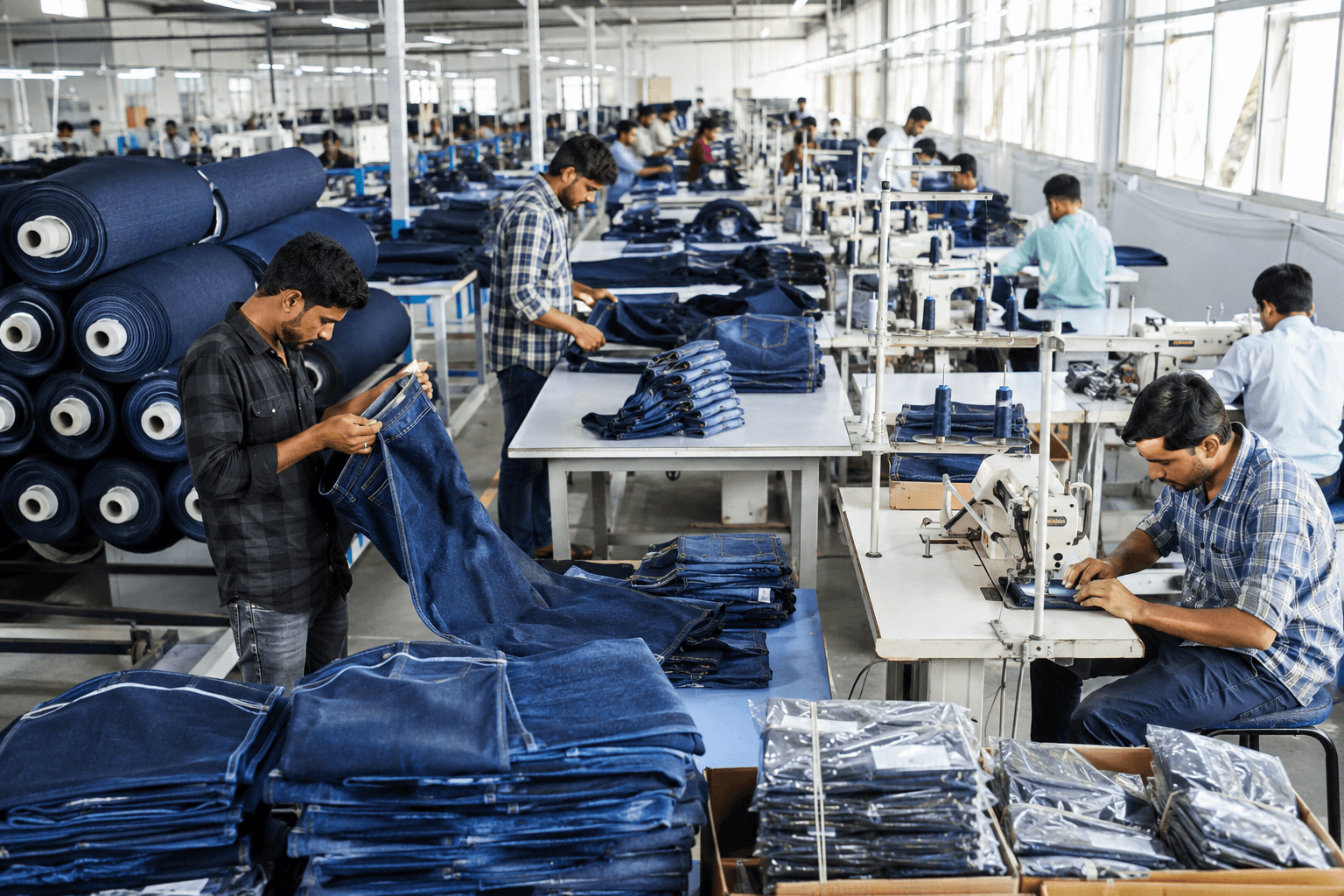
The actual construction stage is completed through specialist cut-and-sew manufacturing, where fabric panels are cut, assembled, stitched, reinforced, and prepared for washing and finishing.
Why Clothing Brands Choose Private Label Manufacturing
Private label manufacturing allows brands to launch or scale collections without investing in their own factory, machinery, technical staff, or production infrastructure.
Key advantages include:
- Lower initial investment
- Faster market entry
- Access to experienced denim specialists
- Consistent production processes
- Full brand ownership
- Flexible order planning
- Easier international expansion
- Reduced operational complexity
- Custom branding and packaging
- Export support
For newer businesses, working with a low MOQ jeans manufacturer for startups may also reduce the financial risk of launching a first collection.
Private Label vs Traditional In-House Manufacturing
| Feature | Private Label Manufacturing | Traditional In-House Manufacturing |
|---|---|---|
| Factory investment | Not required | Very high |
| Machinery | Provided by manufacturer | Must be purchased |
| Skilled workforce | Included | Must be hired and trained |
| Product branding | Your brand | Your brand |
| Production expertise | Manufacturer-managed | Internally managed |
| Scalability | Easier to scale | Limited by internal capacity |
| Export support | Often available | Must be managed independently |
| Time to market | Faster | Usually slower |
| Quality systems | Factory-established | Must be developed internally |
| Operational risk | Lower | Higher |
Private label manufacturing is often the more practical choice for brands that want professional production without building a complete manufacturing operation.
What Can You Customize?
A private label manufacturing program can be customized around your product concept, customer profile, price range, and target market.
Denim Fabric
Brands may choose from:
- Stretch denim
- Rigid denim
- Lightweight denim
- Midweight denim
- Heavyweight denim
- Comfort-stretch denim
- Recycled or lower-impact denim options
The right fabric affects fit, recovery, wash appearance, comfort, shrinkage, durability, and final product cost.
Buyers can review available denim fabric selections before approving samples or bulk production.
Fit
Common men’s denim fits include:
- Slim fit
- Skinny fit
- Straight fit
- Regular fit
- Relaxed fit
- Tapered fit
- Loose fit
Fit development should be based on approved measurements, grading rules, target customers, and the intended fabric performance.
Wash and Finish
Available wash directions may include:
- Dark indigo wash
- Rinse wash
- Stone wash
- Enzyme wash
- Vintage wash
- Light wash
- Faded finish
- Distressed finish
- Clean finish
- Resin or special-effect finish
Wash approval is especially important because denim appearance can change depending on fabric composition, indigo depth, treatment time, chemicals, and finishing methods.
Branding
Private label branding options can include:
- Woven labels
- Printed labels
- Leather or faux-leather patches
- Jacron patches
- Pocket branding
- Hang tags
- Care labels
- Size labels
- Branded buttons
- Branded rivets
- Custom packaging inserts
Additional decoration can be developed through suitable printing methods or custom embroidery services, depending on the product concept.
Hardware
Common hardware options include:
- Waist buttons
- Rivets
- Zippers
- Metal badges
- Snap buttons
- Buckles
- Decorative metal accessories
Hardware should be tested for appearance, durability, corrosion resistance, attachment strength, and compatibility with the wash process.
Packaging
Packaging may include:
- Individual polybags
- Recyclable bags
- Custom boxes
- Barcode stickers
- Size stickers
- Brand inserts
- Tissue wrapping
- Export cartons
- Assortment labels
- Buyer-specific carton markings
Brands can plan their presentation and shipment requirements through custom jeans packaging solutions.
Why Manufacturing Experience Matters
Men’s denim jeans require precision at every stage of production.
Small inconsistencies in cutting, stitching, washing, sizing, or finishing can affect fit, durability, appearance, and customer satisfaction.
An experienced manufacturer understands how to manage:
- Fabric shrinkage
- Pattern accuracy
- Measurement tolerances
- Size grading
- Stitch density
- Seam strength
- Wash consistency
- Shade variation
- Trim durability
- Production efficiency
- Quality inspection
- Export documentation
Brands that need structured production for international markets should work with an export-ready jeans manufacturer that understands packaging, documentation, inspection, and shipping requirements.
Established buyers with larger programs may also consider an OEM jeans manufacturer for global brands when they require detailed technical specifications, controlled production standards, and long-term manufacturing support.